



Select the Right Roses for Your Garden

Roses are one of the best ornamental plants due to their ease of care and general hardiness in harsh environments. Year after year, it is satisfying to see our gorgeous flowers blooming happily in the garden as their scent fills the air.
Choosing your rose, however, can be an anxious moment for new rose-growers. Rose selection must be appropriate for your climate, available space, and the time you’re willing to spend on your rose. This guide will help you on your rose-growing journey, starting with the most important step: choosing the perfect rose.
It is important to note that the relationship between a rose and its gardener is always unique and evolving. Original intentions for a rose may sway- just as our rose adapts to us, we adapt to them. We've even found that roses are somewhat addicting... once you experience the joy of just one, you'll want 30 more!

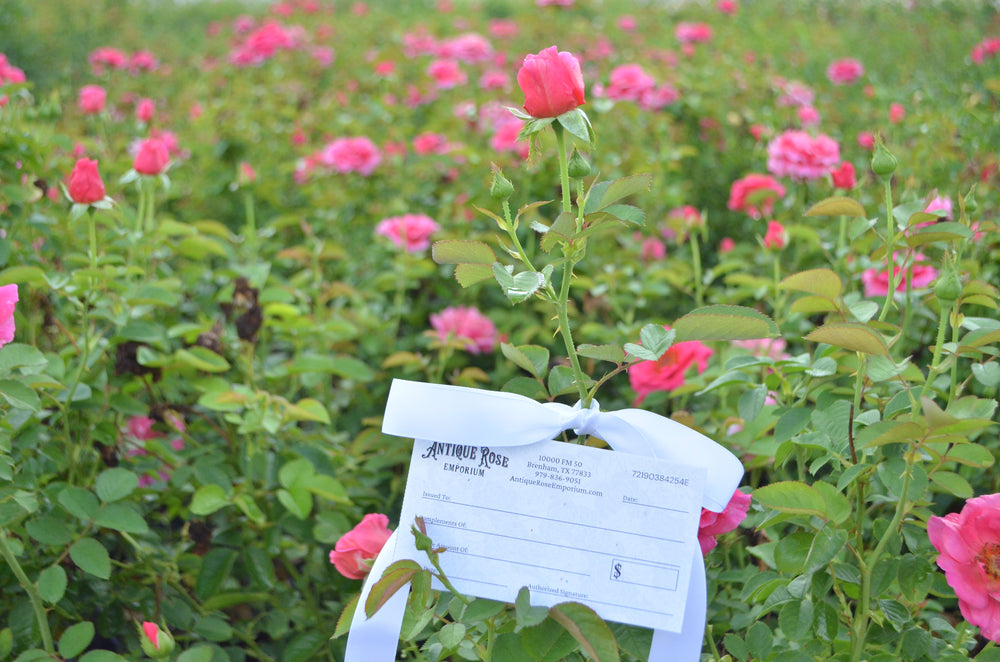
Pictured is Ray Ponton, an Antique Rose Emporium-bred rose (A.R.E. Legacy Roses) at our Nursery & Display Gardens.
Hardiness Zone
Roses have been found growing in just about every climate, from freezing to scalding, and from dry to humid. There is a rose for you! Paying attention to the assigned hardiness zones for roses is the first step to ensuring you’re on the right track. On your rose of interest, open up its description page and scroll down to the layout below. Circled is where you'll find the hardiness (climate) zone range suitable for that rose.

Not sure what your hardiness zone is? Toward the top right-hand corner of our website, enter your zip code and your zone will automatically appear! Example below.

Even for a rose with a wide range of suitable zones, it is not uncommon for a rose in one state to look very different from another rose of the same variety in a different state. These differences include the size of the flower, flower color, flower abundance, and bloom time. Be aware of this when purchasing a rose from another state, as the pictures they display on their website could look slightly different from how that rose would grow in your own state.

Example of Julia Child in Texas, Zone 9, taken in April.

Example of Julia Child in Oregon, Zone 9, taken in June.
Most roses on our website will be suitable for zones 7-10 (double-check regardless). For those in cold climates, check out our Cold-Hardy Roses here.
Sunlight
The general rule of thumb for roses is the more sun, the better. Full sun is ideal for most rose varieties in order to meet their full blooming potential. Flowers will be larger, more abundant, and more frequent in 6+ hours of sunlight daily. For flowers with color variegation or blending, full sun will bring out a stronger contrast.
Roses in partial to full shade will be more susceptible to ailments such as black spot, downy mildew, and powdery mildew. Sun exposure on the leaves evaporates excess water, reducing the chance of disease.
For roses that tolerate partial shade better than most, explore the Hybrid Musk class or see our full Partial Shade Tolerate Collection here.
Humidity
Growing roses in humidity can be frustrating, but do not be discouraged. There are many disease-resistant roses out there that will drastically reduce your problems with ailments such as black spot.
Roses with a high petal count are more subject to “balling” in high humidity. Balling is when a rose bud never fully opens and quickly starts to turn brown on the outer petals (see photo below for example). If you’re in a high-humidity area, avoid roses with a peony-or-cabbage-like formation, as they are more prone to “balling”. China roses and roses within the Sunbelt® series are great bloomers in humidity.
To decrease trapped moisture around your rose, ensure it's in full sun and has proper airflow. Roses in humid climates will not need as much watering as those in dry climates.

Example of "balling".
Size & Growth Habit
Roses greatly vary in size.
There are miniature roses that only get to a foot tall, and climbing roses that climb as long as 40'. You’ll need to know how much space you want to dedicate to a rose while still allowing it room to breathe. Since roses are so forgiving when it comes to shaping and pruning, you can find a rose that gets a little bigger than you want, as long as you are fine with trimming it back often. If you want your rose in a container, we do not recommend selecting a climber or a rose over 5 feet.
See our Container Size & Material Guide here.
Growth habit is also important to consider.
Bushes like Teas and Hybrid Teas generally grow tall and upright, usually making great cut roses, along with some varieties in the Grandiflora and the Floribunda classes. However, some roses are compact with short stems that would be great for privacy, hedge growth, or landscaping. There is also a difference between a regular climber and a rambler. While ramblers are still categorized as climbers, they are Species Roses or Hybrid Species that have more wild growth than mannerly climbers would.

Example of Parade, a mannerly climber at our Nursery & Display Gardens.
Size considerations include the flower size. The “traditional rose” many think of is a singular, large, full-petaled rose. But the shapes and sizes of rose flowers vary significantly. Some roses are single-petaled and resemble apple blossoms. These make great roses for attracting pollinators and birds. Some roses have high petal counts, but the petals are small and condensed. The flower itself would be small, but it makes up for its size by forming large clusters.
*Note that climbers tend to be slower growers. The saying goes: “First year they sleep, second year they creep, third year they leap”. The secret to growing your roses big and strong is patience!
Thorniness
Determining the importance of thorniness depends on what you desire in terms of your rose’s utility. If you are hedging a fence for privacy, you can go one of two ways: “Will a thorny rose be best for security?” or “Will a thorny rose limit me in my ability to maintain it?” If you want a good cut rose or have children around, a nearly thornless rose would be ideal. If you want to keep animals from destroying or peeing in your bushes, a thorny rose would be ideal.

Example of thorns on Calocarpa.
Fragrance & Color
Both fragrance and color depend on the climate and even the individual. Many roses are widely known for their fragrance, which may only have a mild fragrance or no fragrance to the individual- even if that individual has a “good sense of smell”. Fragrance can also depend on the time of year, climate, and the rose's maturity. This is why it can be hard to determine which rose to get based on fragrance alone.
Color is a bit more reliable, but still varies. Likely, if you order a yellow rose, you will get a yellow rose. However, color also depends on time of year, climate, and age, especially for variegated roses or roses that are considered “blends”. Additionally, see here on how color can vary during the heat of summer.
Keep in mind that lighter roses like whites and yellows will show marks and browning more than pink and red roses.
Hip Production
Rose hips are not widely known, even with their ornamental qualities and utility, but Antique Rose Emporium loves them! On rose varieties that produce a bunch of hips, such as Always Hope, Always Dream, Roemer’s Hip-Happy, Butterfly Bliss, etc., you can avoid deadheading after their last bloom of the season, as leaving the blooms will allow the shrubs to reveal their beautiful orange/red fruits! Rose hips add extra color and texture to your garden.
Additionally, rose hips harvested from organically grown rose bushes can be edible and medicinal. Rose hips can be made into teas, jams, jellies, sauces, and nutritional supplements.
Rose hips are known to be anti-inflammatory and good for pain relief, heart health, and the immune system.

Example of hip display on Always Hope.
Repeat vs. Once-Blooming
Many roses, especially modern roses, are bred for their repeat-blooming qualities. They’ll either bloom in flushes on a 6-ish week clock (for example, Hybrid Teas), or they’ll be continuous, with varying phases of blooms on a single plant (for example, Floribundas).
Though repeat-blooming roses are often preferred, once-blooming roses aren’t given enough credit. A common trait of a Species or Hybrid Species rose is being once-blooming. They’ll display one large, beautiful show in the spring, normally blooming in huge clusters. Peggy Martin is a great example of an extremely popular once-bloomer, known for her breathtaking displays, and Lady Banks Yellow is a classic rambler.

Peggy Martin, provided by customer, Jan C.
Species roses are strong roses, considering they must grow well without maintenance in the wild. Additionally, many Antique Roses, also known as “Old Garden Roses”, are once-bloomers, with many redeeming traits such as notable fragrance.
Using the Menu, Filters, & Search on Our Website
Menu
Start with our menu by clicking or hovering over "Shop Roses" at the top of the page, where you'll see a list of rose classes, growth habit, popular collections, color, and more. Select the category most important to you. For example, your priority is a beginner-friendly rose, so choose "Beginner-Friendly Roses" under "Popular Collections". If you aren't sure what's most important to you, simply click "Shop Roses" or "View All", then you can further filter from there.
Filters
See the sidebar (on desktop) or click the "Filter" button (on mobile) to further refine your search, if desired. Many of these options will be similar to the main menu, but you can select multiple at once according to your requirements. Let's say you've already determined you want a beginner-friendly rose and selected that option within the main menu. Additionally, you know you also want it to produce hips AND be suitable for zone 7. So you select "Hips", then "yes", then you select "Zone", then "zone 7". Now you have refined your results to be beginner-friendly roses that produce hips and are suitable for zone 7.
Search
You can also use the search bar at the top right-hand corner of the page to search a specific rose, or even keywords. We highly recommend choosing options under "Collections" that pop up rather than searching for the word alone. For example, if you're searching for heat-tolerant roses, once you type in "heat", our pre-made collection of "Heat-Tolerant Roses" will show.
Conclusion
We hope that with this guide, you will feel more comfortable about selecting roses for your garden.
If you have any other questions regarding more details on rose information, please see our other blogs or reach out to us at gardenquestions@weareroses.com.